About the Temple & Its History
For generations, Naga Maha Viharaya has flourished as a sacred place of merit, devoted to the long endurance of the Buddha's teaching and the flourishing of his dispensation, and nourishing faith, virtue, Dhamma education and the shared religious life of its community.
From the past to the present day, this sacred ground has served as a spiritual centre that deepens the faith and devotion of Buddhists, guides them in the observance of the precepts, makes room for hearing the Dhamma, and hands down the precious values of the Buddha's teaching from generation to generation.
On Poya days above all, devotees come to the temple to nourish their spiritual lives by observing the eight precepts, offering worship to the Buddha and Bodhi pooja, listening to Dhamma sermons, meditating and engaging in acts of merit.
The temple also runs its Daham Pasala with the aim of growing the children's virtue, concentration and wisdom, helping to cultivate in the next generation the Buddha's teachings, moral values, good character and a life lived with loving-kindness.
And so, to this day, Naga Maha Viharaya carries on its religious, educational and social mission without interruption, as a sacred temple where devotees gather in faith and devotion to hear the Dhamma, keep the precepts, perform acts of merit, and pass the noble values of the Buddha's teaching on to the generations to come.
Among the sacred places that shape a temple's spiritual atmosphere, the chaitya, the Bodhi tree and the image house hold a special place. Recalling the Buddha's noble Dhamma, they guide devotees to worship with faith and reverence, to calm the mind and to turn towards a life in keeping with the Dhamma.
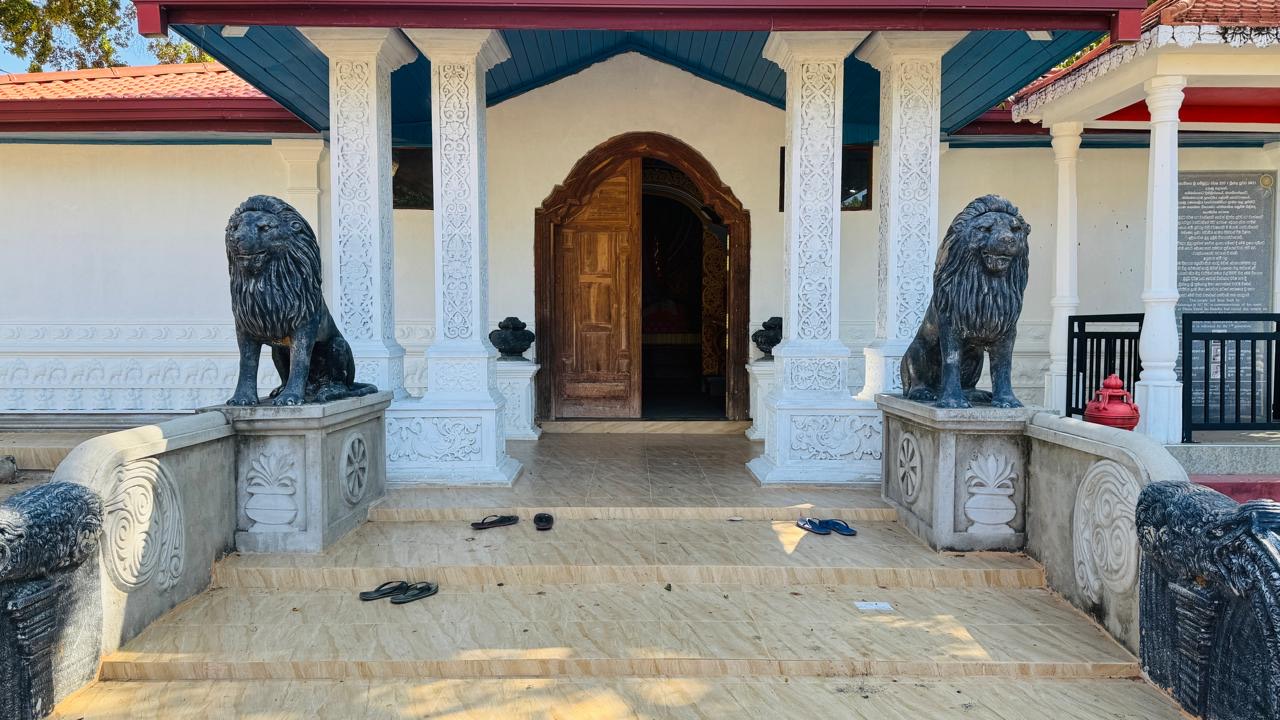
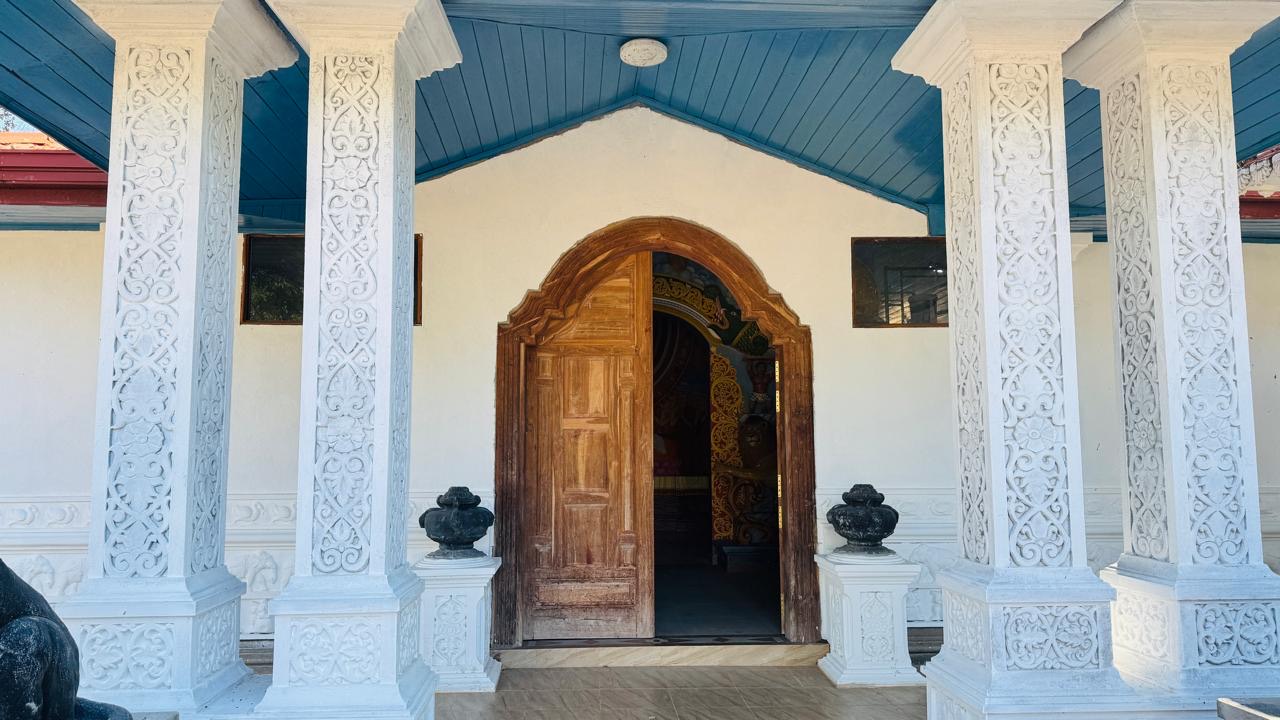
Of these, the Budu Medura of Naga Maha Viharaya is a sacred place of exceptional religious and artistic value. Two lions carved in dark stone flank the steps that rise to the image house, and the stairway leads between finely carved white pillars to a great timber doorway.
Inside, beneath a roof of temple blue, the Buddha image is framed by a magnificent Makara Thorana. The murals around it depict in pictures the Bodhisattva's life, his wondrous journey through the perfections, and the Jataka stories.
These murals are far more than works of art that adorn the temple; they can be seen as lessons in the Dhamma expressed in painting. They recall how, across many lives, the Bodhisattva fulfilled the perfections of generosity, virtue, renunciation, wisdom, energy, patience, truthfulness, determination, loving-kindness and equanimity — and the value, at every turn of life, of freeing oneself from greed, hatred and delusion to choose the good path.
Devotees who walk around the Budu Medura have the chance not only to see these Jataka stories and paintings, but also to understand the Dhamma message they contain.
📱 Hear the Dhamma story behind the paintings
To make this experience of the Dhamma still more meaningful, a QR code has been installed beside each mural.
By scanning the QR code with a mobile phone, a devotee can listen to an account of the Jataka story the painting depicts, its background and the Dhamma message it gives. Presented simply and clearly by the monks who reside at the temple, these accounts help devotees look at each painting and understand the Dhamma meaning hidden within it.
In this way, joining the ancient tradition of Buddhist art with modern technology, the temple makes a special effort to present the Dhamma so that children and older devotees alike can easily understand it.
When you come to the Budu Medura, after paying homage to the Buddha image, we invite you to turn to the murals and scan the QR code, listen to the Jataka story, and take to heart the Dhamma message the painting presents.
The temple year
A Poya day is observed every month. These are the principal occasions; the temple's programme for each is announced on the News & Events page.
Vesak
The Buddha's birth, enlightenment and passing away — the most significant Poya of the year.
Poson
Marks the introduction of Buddhism to Sri Lanka by Arahant Mahinda.
Esala
Commemorates the Buddha's first sermon, the Dhammacakkappavattana Sutta.
Katina
The robe-offering ceremony held after the three-month rains retreat.
Annual Commemorative Merit Ceremonies
Held in September.